Article

Share this article
Follow us on Linkedin
For decades, supply chains were optimized for cost, speed, and global scale. But as volatility intensifies, the same operating models that once delivered efficiency are now exposing businesses to greater risk. In 2026, resilience is no longer a contingency plan. It is a strategic design principle.
For three decades, the global standard has been shaped by a race for absolute efficiency: just-in-time supply chains, endless SKU expansion, hyper-globalisation, and operating models designed to remove every possible margin of slack. In stable times, that model looked smart. In 2026, it looks exposed.
As geopolitical fault lines deepen and AI-accelerated volatility shrink decision-making windows, the systems that once drove speed and scale are becoming liabilities. Efficiency, pursued without limits, has left many organisations with too little buffer, too little flexibility, and too little room to respond when disruption hits.
This article argues that supply chain leaders need to make a strategic shift. Not away from performance, but toward survivability. That means reintroducing safety margins, strengthening regional sovereignty, and adopting a more local-first operating architecture that can absorb shocks without losing control.
The winners in this new era will not simply be the most efficient. They will be the most resilient.
The velocity of collapse: Why 2026 is different.
History offers many examples of collapse, but one thing used to be true: it took time.
Whether we look at the fall of empires or the economic shockwaves of the Great Depression, disruption once moved at a human pace. News travelled slowly. Markets reacted more slowly. Operational consequences took time to spread.
That is no longer the world we live in.
Today, disruption moves at algorithmic speed. A geopolitical event in one part of the world can trigger immediate reactions across markets, energy prices, transport networks, sourcing decisions, and boardroom priorities. The buffer of time has been stripped away.
That is what makes this moment different.
Oil markets reacted immediately. Brent crude climbed sharply, underscoring how quickly geopolitical disruption can translate into economic pressure. In its April 2026 Short-Term Energy Outlook, the U.S. Energy Information Administration reported that Brent averaged $103 per barrel in March and that daily Brent prices reached almost $128 per barrel on April 2. The point is not just that prices moved. It is how fast the signal travelled through the system.
The issue is not simply that the world is unstable. It is that our operating models were built for a world with more time, more predictability, and more room for error.
In 2026, many supply chains no longer have that room.
The myth of global efficiency.
For years, the dominant belief was simple: the leaner the system, the better the business.
That thinking gave us lower inventories, tighter networks, longer sourcing chains, and global operating models designed to remove friction at every step. On paper, it worked. Costs came down. Utilisation improved. Efficiency became the measure of discipline.
But there was a hidden trade-off.
In the pursuit of the lowest possible unit cost, many businesses also decoupled from reality. They replaced strong regional relationships with distant, transactional dependencies that worked only as long as the wider system remained stable.
They also eliminated peace of mind. By compressing decision cycles and automating responses, they reduced the human space required to reflect, assess, and respond with judgment.
And they sacrificed resilience for neatness. Slack was stripped away so completely that even a short disruption can now create outsized operational and financial consequences.
This is the central flaw in the old model. It assumed that stability was the default state and disruption was temporary. But when volatility becomes structural, a system optimised only for speed becomes fragile.
The problem is not efficiency itself. The problem is efficiency without protection.
The ASEAN pivot: Building a multi-loop mesh.
If this era demands a new model, Southeast Asia has an opportunity to help define it.
ASEAN is not just a manufacturing base or a sourcing region. It is one of the few parts of the world with the diversity, industrial breadth, and strategic position to support a more resilient supply chain architecture.
Rather than treating the region as one link in a long global chain, supply chain leaders should start thinking about ASEAN as a multi-loop mesh: a regional network capable of supporting continuity, flexibility, and survivability when global systems come under strain.
That means rethinking resilience in three ways.
Manufacturing in Island Mode.
The old ideal was zero stock. The new question is different: how long can critical operations continue if the wider network is disrupted?
Factories should not depend entirely on uninterrupted global flow. They need strategic decoupling points, targeted buffers, and regional sourcing options that allow them to operate autonomously for a meaningful period when disruption occurs.
This does not mean abandoning discipline. It means recognising that a business with no ability to absorb shock is not disciplined. It is exposed.
Availability over endless variety.
In more volatile conditions, customers tend to value certainty over abundance.
For retailers and consumer businesses, that means product availability may matter more than maximum assortment. In unstable periods, a smaller number of essential items consistently available can create more trust than a vast range that cannot be reliably supplied.
Resilience, in this context, is not about offering everything. It is about protecting what matters most.
Transportation as a web, not a single route.
Many transport networks still depend too heavily on volume concentration and a small number of preferred routes. That may look efficient in a stable environment, but it leaves little room for manoeuvre when bottlenecks appear.
A more resilient model looks more like a web: road, rail, coastal shipping, regional warehousing, and alternative corridors working together as a mesh rather than a single high-volume pipeline.
It may not always appear optimal in a spreadsheet. But when disruption hits, it is far more likely to keep the business moving.
Addressing the friction: The two objections leaders raise.
Any serious resilience discussion runs into two immediate objections. Both are valid. Both deserve a direct answer.
1. The Efficiency Tax
Objection: Won’t regional sourcing, local buffers, and alternate pathways increase cost and make us less competitive?
Response: In a perfectly stable world, possibly. In the world we are in now, that argument is incomplete.
A supply chain with zero stock, no alternative source, and no routing flexibility may appear efficient, but when disruption hits, its real cost is no longer low. It becomes whatever the business must pay for delay, shortage, lost revenue, expediting, and recovery.
This is the point many leadership teams are now confronting. Safety margins are not waste. They are an insurance premium. They are the cost of preserving continuity in a world where interruption is no longer rare.
The real trade-off is not between cheap and expensive. It is between marginally higher fair-weather cost and the ability to remain operational in bad weather.
That is not inefficiency. That is survivability.
2. The complexity barrier.
Objection: We have spent years harmonising our ERP and standardising globally. Wouldn’t regional decoupling push us backward into complexity and technical debt?
Response: Not if it is done properly.
This is where mature architecture matters. A resilient operating model does not require dismantling the global standard. It requires supporting that standard with the right circuit breakers.
For SAP-centric organisations, that means keeping the core ERP governed and stable, while enabling local logic, regional flexibility, and island-mode capabilities through a federated architecture supported by SAP Business Technology Platform.
That gives organisations the best of both worlds: global visibility without total global vulnerability, standardisation where it adds value, and local adaptability where it is essential.
This is not a retreat from clean core. It is what clean core maturity looks like in a more volatile world.
The new KPI: From cost obsession to sovereignty score.
If leadership teams want to move beyond the at-any-cost mentality, they need to redefine what winning looks like.
Traditional metrics still matter. Unit cost, inventory turns, and lead time remain important. But on their own, they tell us how efficient the system is in calm conditions. They do not tell us how stable it is under pressure.
That is why resilience needs to be measured more directly.
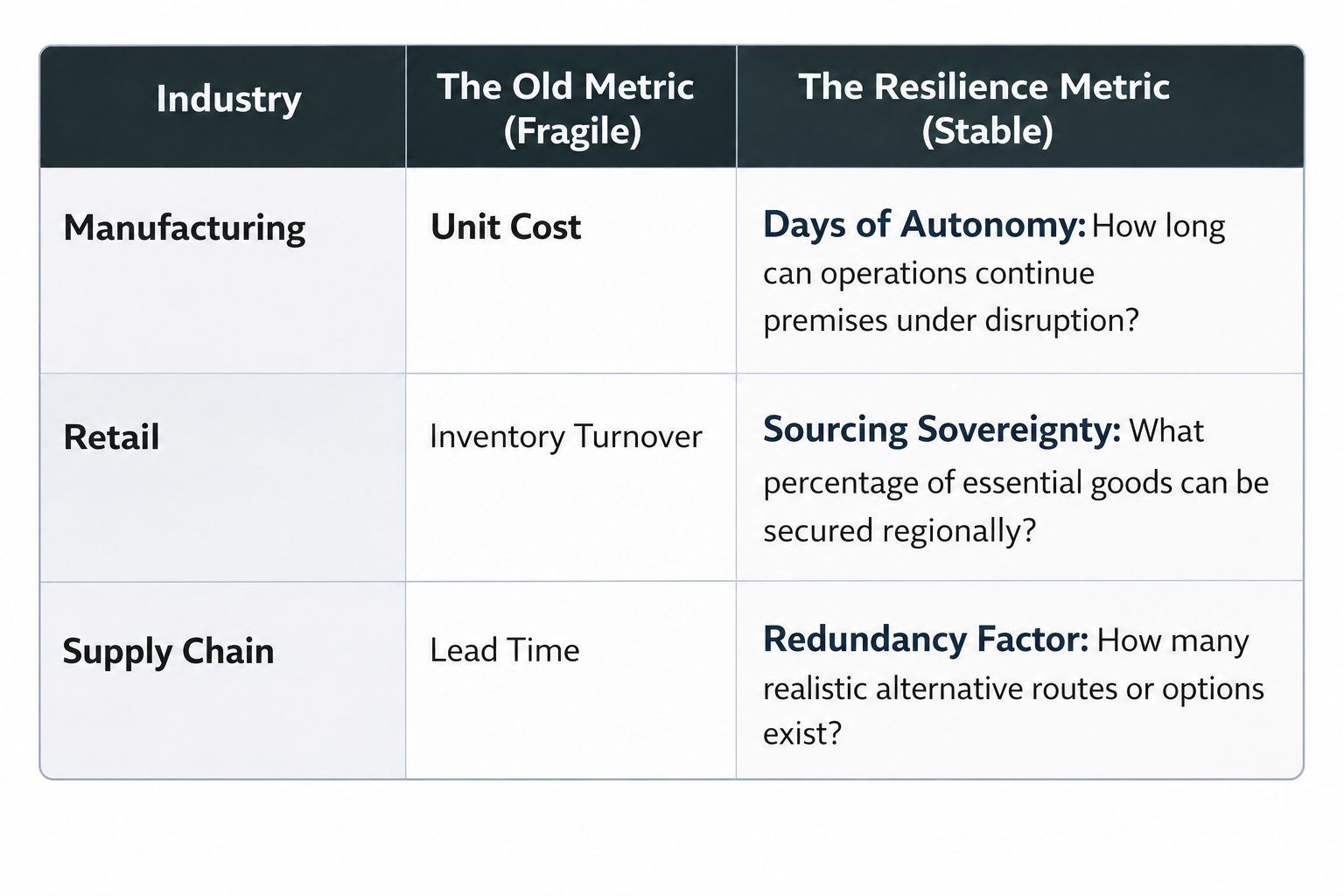
These are not abstract ideas. They are practical indicators of whether a business can continue functioning when the wider system becomes unstable.
What gets measured shapes behaviour. If resilience is not on the scorecard, it will remain secondary in decision-making.
Integrity as the ultimate buffer.
At its core, this is not only a supply chain issue. It is a leadership issue.
The at-any-cost era rewarded speed, compression, and optimisation without always asking what was being lost in the process. But the world we are entering demands something more grounded. It demands judgment. It demands the courage to accept that not all slack is waste. And it demands the integrity to build systems for reality, not for perfect conditions.
That means reintroducing safety margins in three forms: Physical Buffer where continuity truly matters. Digital Architecture that allows flexibility without losing control. Cognitive The decision space leaders need to respond well, not just react fast.
This is not about slowing down for the sake of it. It is about ensuring that when the wider system comes under pressure, your organisation can remain steady, responsive, and intact.
In 2026, integrity may be the only buffer that does not disappear when conditions deteriorate.
The question for the board.
If the global grid went dark tonight, would your operations remain a stable, sovereign island within the storm, or would they become another exposed fragment in a chain built only for fair weather?
How Westernacher can help?
Westernacher works with organisations to turn resilience from a boardroom concern into an operational capability. That includes assessing exposure across planning, sourcing, logistics, and digital architecture, identifying where efficiency has gone too far, and defining practical steps to improve continuity without losing control of the core.
For SAP-driven businesses, that means building resilience in a way that supports clean core principles while giving regional operations the flexibility they need to respond under pressure.
If your business is rethinking how to balance efficiency with resilience, reach out to Westernacher to continue the conversation.

David Cockbaine
Practice Director Digital Core SEA, Westernacher Consulting
Reference: U.S. Energy Information Administration, Short-Term Energy Outlook, April 2026.