Article

Why SAP Transformation needs a new operating model?

Go-live is not the finish line for SAP transformation. It is the starting point.
Westernacher favicon
Share this article
Follow us on Linkedin
Many SAP programmes still follow a familiar pattern: a big business case, a long delivery cycle, rising cost pressure and a high-stakes cutover. Yet by the time the platform is live, the business has often moved on.
That is why leaders need to rethink the mega-project mindset.
The real question is not only, “How do we move to SAP S/4HANA?” It is, “How do we build an SAP platform that keeps improving as the business changes?”
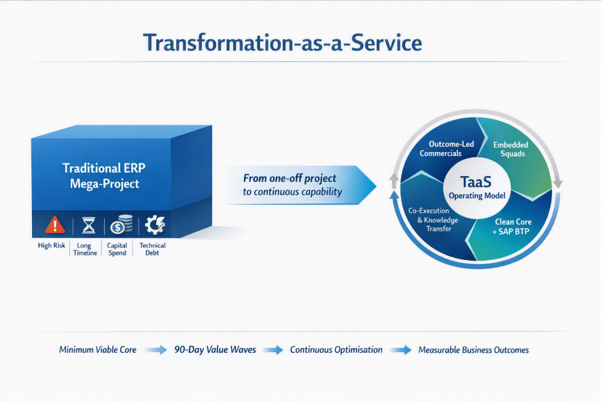
This is where Transformation-as-a-Service becomes relevant. Not as a replacement for major SAP programmes, but as the operating model that keeps transformation alive after the foundation has been built.
Large SAP initiatives still matter. S/4HANA migrations, ERP consolidations and process transformations create the foundation. But the organisations that gain most value are those that continue to optimise, innovate and adapt once that foundation is live.

Continuous Optimisation, Innovation and Adoption

In other words, transformation needs to become a capability, not just a programme.
Why SAP Transformation Needs a New Operating Model

What changes with Transformation-as-a-Service?

For me, four shifts stand out:
  • Outcome-aligned commercials: predictable operating spend linked to measurable business outcomes, rather than large upfront commitments and endless change orders.
  • Embedded cross-functional squads: architects, process specialists, change leads and data experts working as a standing delivery capability that can scale with priorities.
  • Composable architecture: modular platforms, APIs and clean data layers that allow individual capabilities to improve without destabilising the wider landscape.
  • Co-execution and knowledge transfer: internal teams co-design, co-configure and co-deliver each improvement wave, building the capability to sustain change.

Why this matters now?

For organisations moving to SAP S/4HANA, the opportunity is bigger than a technical migration. It is a chance to simplify the core, reduce unnecessary complexity and create a platform that can support continuous improvement.
That fits closely with SAP’s Clean Core direction. Keep the ERP core as standard as possible. Use side-by-side extensions, automation and integration where differentiation is needed. Make future upgrades easier, not harder.
A practical TaaS journey could start with a viable SAP core, followed by regular improvement waves focused on the areas that matter most: finance automation, supply chain visibility, customer integration, analytics or adoption.

The leadership case is simple.

For executive teams, the attraction is not just technical flexibility. It is better control over value, risk and spend:
  • Faster time-to-value: value is released through early foundations and regular capability waves, rather than waiting for a single big-bang cutover.
  • Lower delivery risk: change is introduced in smaller, governed increments, reducing operational exposure and making course correction easier.
  • Cleaner architecture: the ERP core remains easier to upgrade, integrate and protect from unnecessary customisation.
  • Better spend control: investment can be aligned to a rolling backlog of business outcomes, with priorities adjusted as needs change.
  • Stronger internal capability: co-execution helps business and IT teams build the muscle memory needed to sustain change after each wave.

From implementation project to improvement engine.

The organisations that get the most from SAP S/4HANA will not treat it as a one-off technology replacement. They will treat it as a platform for ongoing business improvement.
That requires a different mindset: cleaner architecture, smaller value-led increments, stronger business ownership and governance that looks beyond the go-live date.

Three questions worth asking.

If your organisation is planning, delivering or recovering an SAP transformation, it may be worth stepping back and asking:
  1. Is our technical core simple enough to keep evolving?

  2. Does our commercial model allow us to prioritise value in smaller, faster waves?

  3. Are we measuring transformation success beyond go-live?
For me, this is the real shift: SAP transformation is no longer just about delivering a system. It is about building the capability to keep improving the business through that system.
What would change if we managed SAP transformation as a continuous capability rather than a one-off programme?
Capabilities
Inspiration
Responsibility
People
We
Choose your language

Write to us​ .

Capabilities
Inspiration
Responsibility
People
We
Choose your language

Use of cookies

Westernacher uses cookies to provide you with a more responsive and personalized service. By using this site you agree to our use of cookies. Please read our cookie notice for more information on the cookies we use and how to delete or block them.