Article

Share this article
Follow us on Linkedin
A lights-out warehouse, a facility where human intervention ranges from minimal to non-existent, has been a topic of discussion in recent years. In fact, the volume of online searches on warehouse automation has gained significant traction, with an increase of over 450% just in the last 5 years.[1] Looking at the global market data for warehouse automation, its rapid growth is clear. In 2025, it was valued at US$29.98B and it is projected to reach US$ 65.74 by 2031, with a CAGR of 13.98% over this period. [2] Gartner also predicts that, by 2030, 50% of new warehouses in developed markets will be designed as robot-centric facilities.[3] It is therefore of interest to better understand what these advanced facilities are and why warehouses are getting more automated?
First, let’s start by exploring what lights-out warehouses are. These are facilities with highly sophisticated automation systems capable of executing most of the daily warehousing operations with such little human intervention that lighting and temperature controls do not need to be adjusted for human workers. Instead, autonomous robots, automated material handling systems, and automated workstations can carry out the movement of materials throughout all their cycles.
Though a lights-out warehouse implies a fully autonomous site, warehouse automation is not an all-or-nothing term. It is rather a spectrum consisting of different building blocks that can support various processes and operations. Lights-out warehouses simply leverage these automation building blocks and orchestrate them together so that a seamless flow of materials can take place. However, it is worth noting that most warehouses today fall anywhere between a fully manual operation (63%) and a fully automated one (6%), with many sites having a mixture of automated and manual processes (31%) as reported by Kardex.[4] This raises the question: if such a large majority of warehouses still operate manually, then why is the popularity of warehouse automation skyrocketing?
Key drivers for warehouse automation:
1. The impact of e-commerce: market size and customer expectations
The current digital marketplace is increasingly being tailored around the convenience of online customers. Just in the USA, the total sales from e-commerce broke a new all-time high in Q1 of 2026, with a total of US$327.9B, setting a new record of 17% of the total retail sales.[5] Similarly, the global e-commerce market continues to grow, with a projected market size of US$6.88T in 2026, accounting for 21.1% of all retail sales.[6] This shifts the pressure from the retailers to the distribution centers, where workers must facilitate the picking, packing, and fulfillment of each individual order instead of replenishing a local store with bulk shipments that are quicker to execute on the warehouse floor. In addition, customers keep expecting faster deliveries, with next-day or even same-day deliveries now being the norm. As a result, facilities that have not yet automated their workflows to account for the various logistical scenarios that this presents must pass the strain back to the workers who have to process a higher number of complex orders in shorter timeframes.[7]
2. The labor force: productivity decline, rising costs, and the labor shortage
After its peak in 2022, with a maximum of 1.915M warehousing jobs in the USA, the industry plateaued, reaching a total of 1.886M jobs in 2025. At the same time, the with the main driver behind this being the rise of e-commerce. As orders become smaller and more frequent, each unit of output requires additional time and effort per employee to fulfill it.
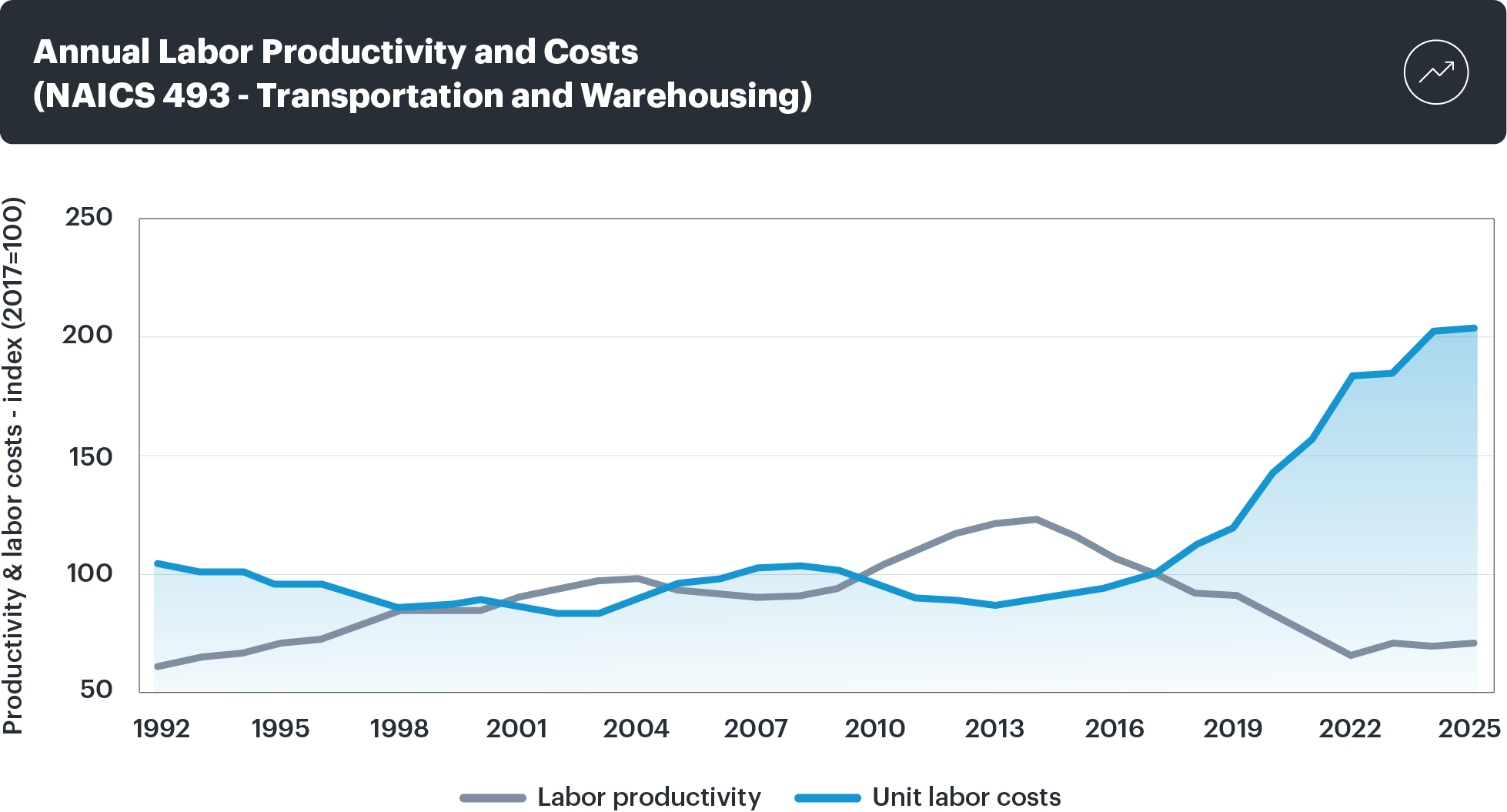
Warehouses are also facing challenges to keep their facilities staffed. With a turnover rate of 48% in 2025,[9] finding skilled labor has become increasingly difficult, especially as the experience with modern warehouse technologies becomes an essential qualifier for these jobs.
While businesses struggle to attract and retain workers, workers are increasingly looking for safer working conditions. A 2025 survey from Zebra Technologies found that 70% of warehouse workers reported concerns with injuries in the workplace.[10] The U.S. Government Accountability Office also found that warehousing is the industry with the highest estimated rate of injury. This is particularly true for e-commerce sites carrying out last-mile deliveries, which saw a 23% uptake in the rate of serious injuries from 2018 to 2022, mainly due to the rise of online shopping. [11],[12]
Organizations can take proactive steps to mitigate the impact of retiring workers by shifting to automation, and given that the implementation of these systems requires a substantial amount of time, companies should consider their technological transformations sooner rather than later.
3. Space constraints
The price of industrial real estate has been on the rise for over a decade. [15] This increase in costs, along with the competition for available space near urban areas, continues to pressure warehouses to find ways to optimize their existing floor space. For this, many modern solutions are offering ways to leverage vertical space as an alternative to the expansion of the physical floor area.
With all of this in mind, it is only natural for businesses to turn to automation as a solution to overcome the challenges of the current landscape as it offers a way to streamline operations, improve efficiency, and reduce their dependence on human workers. It is also no wonder why the global market for warehouse automation is expected to grow at such a fast pace. Today, companies are not necessarily choosing to implement advanced automation; they are being pushed to adopt it to remain competitive. The ceaseless growth of e-commerce, the rising customer expectations, and the decrease in labor productivity continue to force companies to look for opportunities to make their operations more efficient and cost-effective through automation. Organizations are also looking for ways to become more resilient to the volatility of global markets. Automation can provide them with the tools needed to scale their capacity, with solutions such as robots-as-a-service that allow warehouses to adjust the size of their robotic fleets to meet their demand, on demand.
However, in order for all of the automation building blocks to work together, businesses need to have an advanced Warehouse Management System (WMS) capable of integrating and orchestrating them seamlessly to deliver the results they need. SAP Extended Warehouse Management (EWM), SAP’s flagship WMS, provides a comprehensive array of automation capabilities to integrate these advanced automation solutions, giving businesses the power to orchestrate and scale their operations as they grow.
To learn how SAP EWM can integrate with autonomous warehousing robots and automation systems, check out our white paper on Smart Warehousing:
Start your digital transformation with Westernacher.
If you want to achieve your warehousing vision faster, let the expert team from Westernacher guide you. Contact us today to explore how we can support your warehouse transformation journey.
References:
- Google Trends. (2026). “Warehouse automation” — Worldwide search interest, past 5 years. Retrieved October 8, 2026. Link
- Axis Intelligence Research. (2026, July 3). *Warehouse automation statistics 2026: Market size, ROI & adoption data. Link
- (2026, April 13). Gartner Predicts Half of New Warehouses Built in Developed Markets Will be Human-Optional Facilities by 2030. Link
- (2025, December 23). Everyone Says Integration is Essential. So Why are 63% of Warehouses Still Manual? Link
- S. Census Bureau. (2026, August 18). Quarterly Retail E-Commerce Sales: 2nd Quarter 2026. U.S. Department of Commerce. Link
- (n.d.). Global ecommerce sales growth report. Link
- Stevens, M. (2023, June 26). Why Policymakers Should Support Robotic Automation to Solve the Productivity Crunch in Logistics Facilities. Information Technology and Innovation Foundation (ITIF). Link
- S. Bureau of Labor Statistics. (n.d.). Industry Productivity Viewer. U.S. Department of Labor. Link
- S. Bureau of Labor Statistics. (2026, September 29). Job Openings and Labor Turnover—August 2026. Link
- Zebra Technologies. (2025, February 27). 70% of Frontline Workers Report Rising Concerns with Injuries on the Warehouse Floor. Link
- S. Government Accountability Office. (2024, September 18). Workplace Safety and Health: OSHA Should Take Steps to Better Identify and Address Ergonomic Hazards at Warehouses and Delivery Companies (GAO-24-106413). U.S. Government Accountability Office. Link
- S. Government Accountability Office. (2024, October 9). As Online Shopping Increases, So Do Concerns About Delivery and Warehouse Workers’ Safety. U.S. Government Accountability Office. Link
- S. Census Bureau, Center for Economic Studies. (n.d.). Quarterly Workforce Indicators (QWI): LED Extraction Tool. U.S. Department of Commerce. Link
- Smith, M. (2025, November 12). North Carolina’s Manufacturing Workforce Faces Growing Retirement Risk. North Carolina Department of Commerce. Link
- S. Bureau of Labor Statistics. (n.d.). Producer Price Index by Commodity: Real Estate Services (Partial): Industrial Buildings, Gross Rents (WPU431103). Retrieved from FRED, Federal Reserve Bank of St. Louis. Link