Share this aricle
Follow us on Linkedin
Transformation-as-a-Service (TaaS) offers a more practical way to modernise SAP landscapes continuously, safely and with measurable business value.
For many organisations, SAP transformations still carry the same familiar reputation: a large business case, a multi-year programme, rising cost pressure, extensive workshops and a high-risk go live. By the time the platform is live, the business context has often moved on.
That is why leaders need to challenge the mega-project mindset. The real question is no longer simply, “How do we migrate to SAP S/4HANA?” It is, “How do we create a platform that can keep evolving as the business changes?”
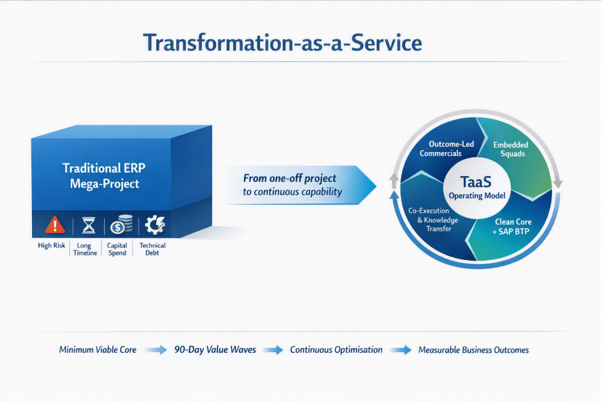
Transformation-as-a-Service offers a different answer. Instead of treating transformation as a one-off programme, it creates a continuing capability: planned, governed and funded in smaller increments, with progress measured against business outcomes.
1. What TaaS Changes
TaaS reshapes enterprise change around four practical design principles:
- Outcome-aligned commercials: predictable operating spend linked to measurable business outcomes, rather than large upfront commitments and endless change orders.
- Embedded cross-functional squads: architects, process specialists, change leads and data experts working as a standing delivery capability that can scale with priorities.
- Composable architecture: modular platforms, APIs and clean data layers that allow individual capabilities to improve without destabilising the wider landscape.
- Co-execution and knowledge transfer: internal teams co-design, co-configure and co-deliver each improvement wave, building the capability to sustain change.

2. Why This Matters for SAP S/4HANA
The move to SAP S/4HANA should be more than just a technical migration. It is an opportunity to simplify, standardise and create a foundation for continuous improvement. Under a TaaS model, organisations establish a clean, standard core first, then modernise priority capabilities through controlled, value-led waves.
This aligns naturally with SAP’s Clean Core strategy. Rather than embedding custom code directly into the ERP core, required extensions, automations and integrations can be built side-by-side using SAP Business Technology Platform. The result is a more flexible architecture that can absorb ongoing SAP innovation without repeatedly triggering costly regression cycles.
A typical TaaS journey starts with a Minimum Viable Core, delivered using standard processes and essential data migration. Once the foundation is live, quarterly capability waves can focus on high-impact areas such as finance automation, supply chain visibility, customer integration or analytics. Optimisation becomes continuous rather than episodic.
3. The Leadership Case
For executive teams, the value of TaaS is not only technical. It changes the economics, risk profile and governance of transformation:
- Faster time-to-value: value is released through early foundations and regular capability waves, rather than waiting for a single big-bang cutover.
- Lower delivery risk: change is introduced in smaller, governed increments, reducing operational exposure and making course correction easier.
- Cleaner architecture: the ERP core remains easier to upgrade, integrate and protect from unnecessary customisation.
- Better spend control: investment can be aligned to a rolling backlog of business outcomes, with priorities adjusted as needs change.
- Stronger internal capability: co-execution helps business and IT teams build the muscle memory needed to sustain change after each wave.
4. From System of Record to Engine of Growth
The organisations that gain most from SAP S/4HANA will be those that treat it as a foundation for continuous business improvement, not as a one-off technology replacement. TaaS helps make that shift practical by combining a clean core, modular innovation, embedded delivery capability and outcome-led governance into a model that can evolve with the business.
In this model, transformation does not end at go-live. It becomes a managed capability: continuously prioritised, continuously measured and continuously improved. That is the real promise of Transformation-as-a-Service.
5. A Practical Next Step
If your organisation is preparing for SAP S/4HANA, now is the right time to test whether your transformation approach is designed for a one-off migration or for continuous value creation. Three questions are worth asking:
1. Is your technical core ready? Assess custom code, integration complexity and readiness for a clean-core SAP S/4HANA architecture.
2. Does your commercial model support agility? Review whether your funding and procurement model supports outcome-led, iterative delivery.
3. Are you measuring the right value? Define the business metrics that will guide each transformation wave, such as adoption, automation, cycle time and working capital impact.
If this resonates with your SAP roadmap, let’s talk. Westernacher Consulting can help assess your ERP landscape, clean-core readiness and first value waves, and shape a practical path towards continuous transformation. Get in touch with us now.