
Share this aricle
Follow us on Linkedin
As mentioned in our white paper, warehouse automation is no longer driven by a single technology. Today’s operations rely on a mix of robotic systems, each designed to solve a different type of challenge. Understanding these categories helps companies plan how they fit into SAP EWM processes and where each technology delivers the most value.
Autonomous Mobile Robots (AMRs).
AMRs have become flexible workhorses of intralogistics. They move freely through the warehouse, react to real‑time conditions, and handle everything from transport tasks to goods‑to‑person workflows. Their strength lies in adaptability – they scale easily and fit into dynamic environments without heavy infrastructure.
Automated forklifts and AGVs.
Automated forklifts take over repetitive pallet moves and stabilize internal pallet logistics. Unlike AMRs, they follow more structured paths but offer high reliability for standard transport tasks. They’re ideal when safety, repeatability, and consistent pallet flows are the priorities.
Robotic arms for picking and palletizing.
Piece picking, palletizing, depalletizing – robotic arms have become highly capable of tasks that previously depended on manual precision. They bring accuracy and consistency to high‑volume operations and integrate well into EWM‑driven task flows, especially in areas where speed and repeatability matter.
Shuttle systems and AS/RS.
High-density systems like shuttles, miniloads, and crane‑based AS/RS deliver fast, predictable throughput and excellent space utilization. They excel in structured environments with large SKU counts and constant demand, and they integrate tightly with SAP EWM when real‑time inventory accuracy is essential.
Bringing it all together with SAP EWM.
Each robotic type delivers value in its own way, but the real strength comes from combining them under one process layer. SAP EWM assigns tasks, manages priorities, and ensures that every robot – regardless of type – plays the right role at the right time. That’s when a warehouse shifts from isolated automation to a coordinated, scalable operation.
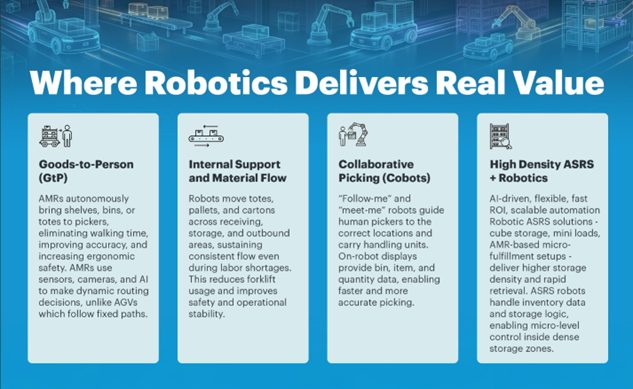
While these four robot types form the foundation of modern automation, the real value appears in how they support the four major warehouse workflows: goods-to-person, internal flow, collaborative picking, and ASRS-driven fulfillment.
Real-world use cases transforming warehouse operations.
Across industries, robotics eliminate bottlenecks and enable new fulfillment models. Here are the most impactful use cases from today’s warehouses:
Next steps.
Ready to explore what robotics could unlock in your warehouse?
Our team can help assess your automation maturity and build a roadmap tailored to your operations.