Share this article
Follow us on Linkedin
Mergers and acquisitions (M&A) are often seen as a fast track to growth. They promise access to new markets, additional capabilities, and scaling that would take years to achieve organically. On paper, this logic is compelling. Yet in practice, many M&A struggle to deliver on that promise. The reason is rarely the deal itself; more often, is what happens afterwards.
This new blog series explores use cases of business transformation management and how Westernacher’s expertise contributes to successfully execute them in projects. Follow for insight on tool-supported approaches and success stories of digitally transforming businesses, from strategy through execution.
Commercially aligned, operationally conflicting?
Despite best intentions, M&A initiatives continue to be driven primarily by financial and legal considerations. Integration planning – particularly for IT and operations – is postponed until the end of the process, when key decisions have already been made. This imbalance is reflected in recent research by Boston Consulting Group. A BCG M&A organisation survey (2024) shows that deal teams prioritise strategic rationale (60%), negotiation (57%), and financial analysis and valuation (53% and 52%), while integration planning and post-merger integration are considered a top priority by only 14% of respondents. Communications rank even lower, at just 5%. This highlights a persistent gap between deal execution and integration readiness.
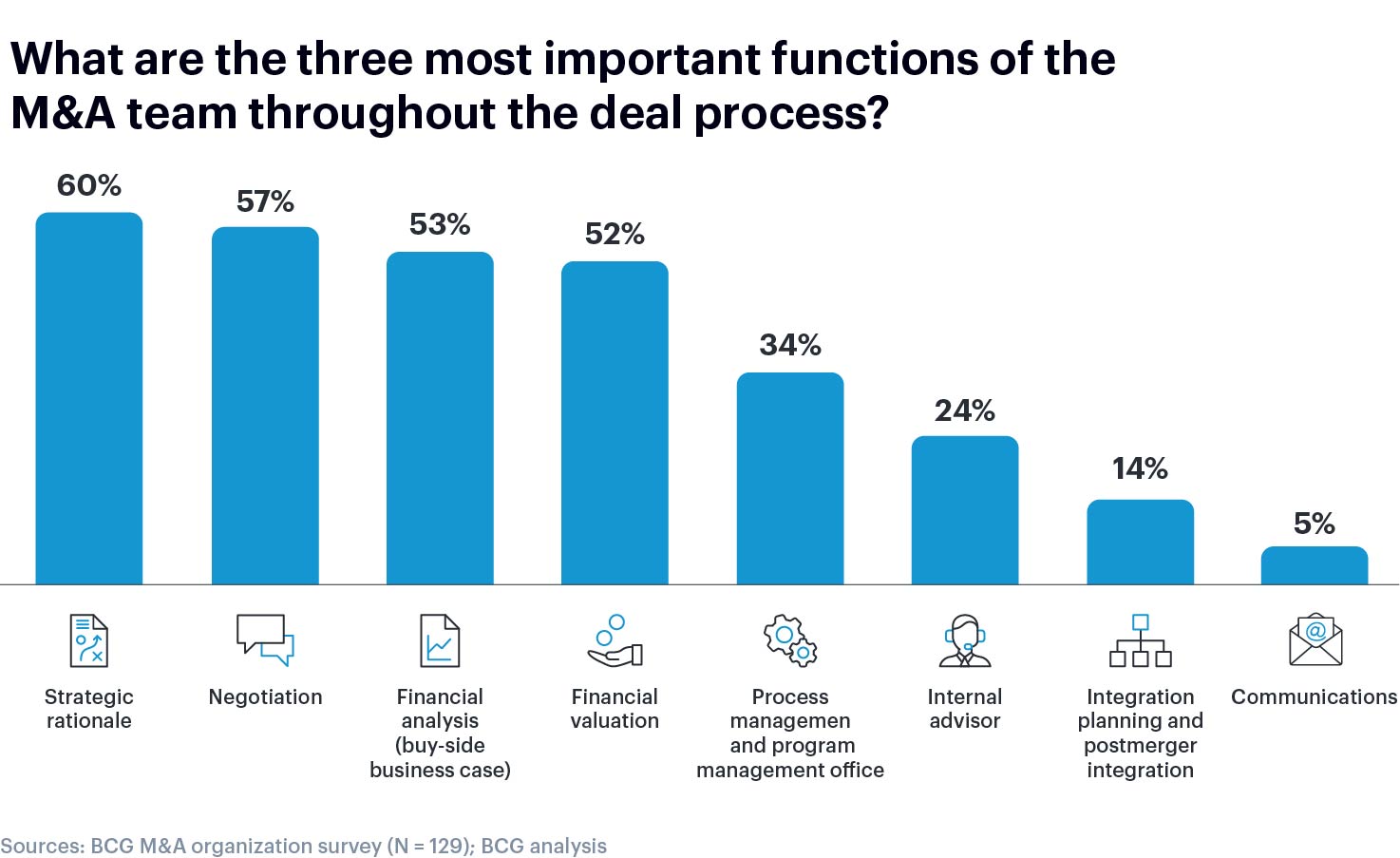
BCG’s findings align with the challenges that can be observed in our transformation programs: insufficient early focus on integration, IT, and operational readiness leads to prolonged timelines, delayed synergy realisation, and avoidable complexity post-close. When integration planning is treated as a downstream activity rather than a core deal discipline, organisations limit their ability to realise value and manage risk effectively across the full M&A lifecycle. As a result, many M&A initiatives do not reach the initial targets because the effort required to translate strategy into an integrated operating model is underestimated at the outset.
Hidden complexities of M&A.
Core to any M&A is the organisational transformation. Success depends on the ability to align four closely related dimensions:
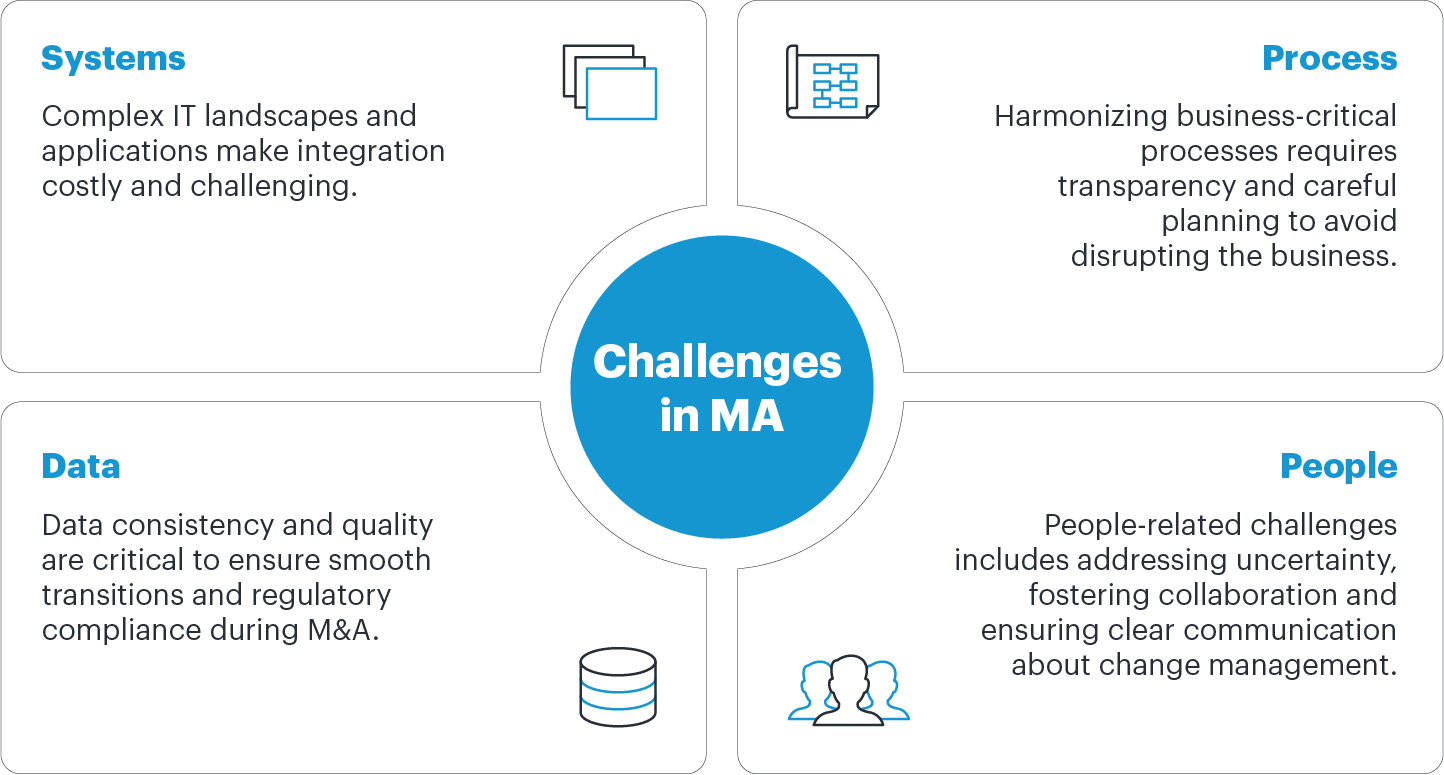
While these dimensions are often discussed individually, in practice they are deeply interdependent; treating them in isolation is one of the main reasons integration efforts struggle.
Enterprise Architects at the centre stage.
Systems are usually the most visible challenge. Merging organisations often bring with them complex IT landscapes with multiple ERP systems, legacy applications, and interfaces built over years. Changes to systems immediately affect business processes, data structures, and user roles and without early transparency, making the right decisions becomes challenging.
Efficient, value-adding processes are key to the success of the organisation. Transparency over their integration points, business criticality and impact on the company’s competitive advantage is crucial. For instance, adopting the acquirer’s standard process might reduce complexity, but could also disrupt the target’s high-performing business model if applied without careful analysis and planning.
Data acts as the connective tissue between systems and processes. Differences in master data models, data ownership, and data quality often surface late, when reporting, compliance, or integration testing begins.
The best efforts in smoothly integrating the two Business and IT landscapes will not yield success if the people i.e. employees are overlooked. A change readiness which is not addressed adequately with sufficient communication and enablement can quickly lead to change resistance, operational issues or increasing attrition.
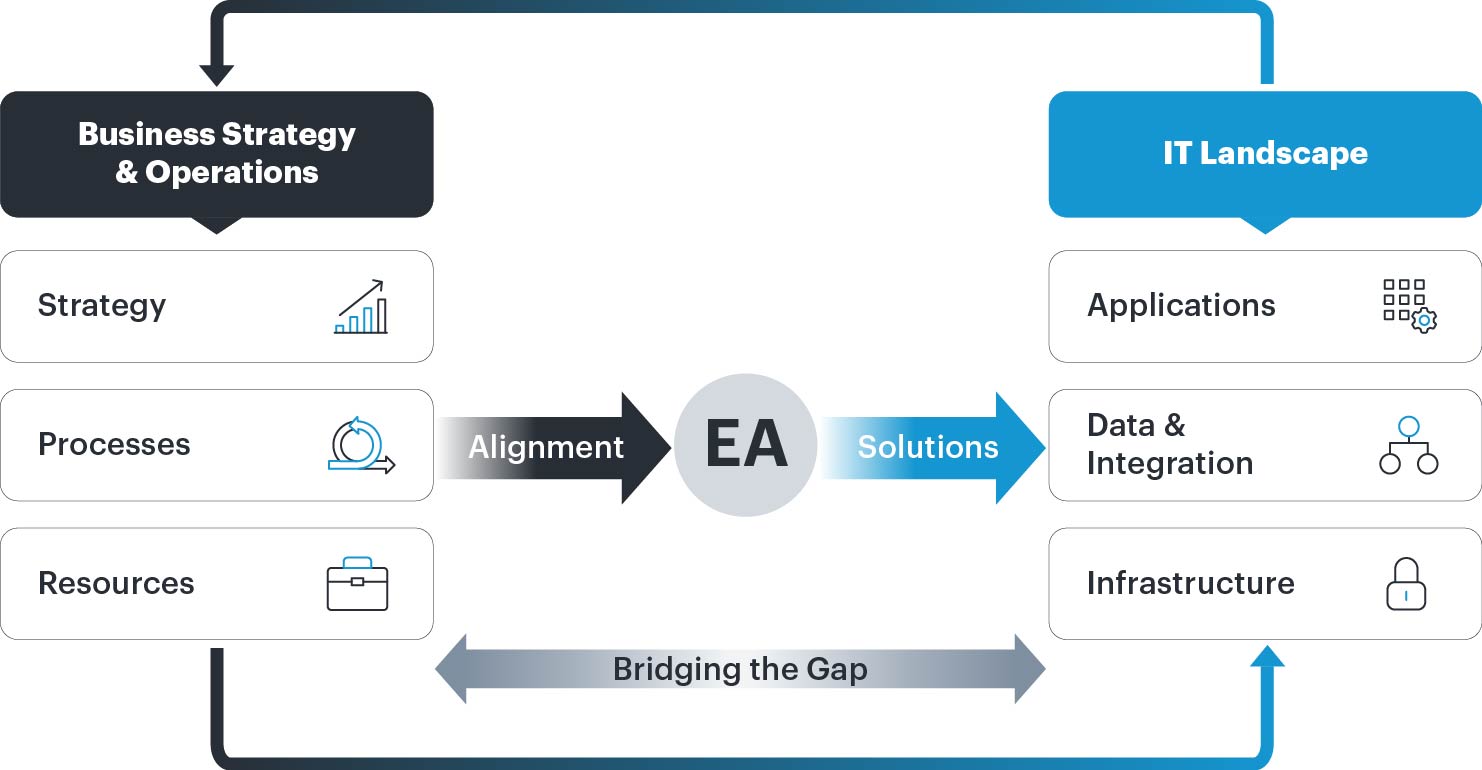
To align the strategies of business with IT, a new approach for managing IT has been developed called Enterprise Architecture. Just as architecture provides a blueprint for constructing a building, Enterprise Architecture provides a blueprint and roadmap for aligning business strategy with IT.
A holistic approach focussing on both Business operations and IT landscapes together is required. This is precisely the playing field of enterprise architects, a role which has become increasingly important across industries in recent years. Digital transformations accelerated this new focus by demanding experts with knowledge in both worlds, ensuring competitive business capabilities are supported by cutting-edge technologies.
M&A with their natural characteristic of relying on all four transformation dimensions (systems, processes, data and people) benefit from enterprise architecture:
- Create early transparency across both organisations, for example, by mapping business capabilities, key processes, current maturity level and supporting applications
- Assess integration options and trade-offs before irreversible commitments are made, such as deciding which capabilities to integrate, retain, or separate
- Design a target architecture that supports strategic business objectives, not just short-term cost synergies
- Reduce complexity, control integration costs, and minimise disruption, by sequencing changes in a structured and dependency-aware manner
An architecture-driven integration approach improves strategic decision-making, protects operational performance, and ultimately strengthens the organisation’s competitiveness. That is why Westernacher’s enterprise architects play a central role in M&A initiatives and actively shape integration decisions across systems, processes, data, and people.
As one of our customers put it:
“The deal closed quickly. What made the difference was having a clear architectural view that allowed us to integrate without losing momentum or people.”
For more insight on our M&A methodology including tool-supported transformation activities, get in touch with:
Matthias Engelmayer
Senior Consultant Business Transformation Management, Westernacher Consulting

Matthias Engelmayer
Senior Consultant Business Transformation Management, Westernacher Consulting