Article

Share this article
Follow us on Linkedin
Building on the first article in this series – which explained why enterprise architects are essential to M&A success – this follow-up focuses on the underestimated complexity of divestitures. Unlike mergers, which bring organisations together, divestitures require the delicate process of taking them apart. They are not simple “undo” operations but demand rigorous planning, clear architectural oversight, and a deep understanding of how to disentangle processes, systems, data, and organisational structures without destabilising the remaining business. And above all, they demand empathy, as people behind the processes experience profound change.
This article explores how enterprise architecture provides the structure, clarity, and strategic guidance needed to execute divestitures effectively – ensuring continuity, compliance, and long-term value creation. Drawing on the SAP Enterprise Architecture Framework and Westernacher’s experience with SAP-centric separations, we show how a structured, people-aware approach can turn one of the most challenging corporate events into an opportunity for renewal.
The Human Side of Divestitures: Why People Are the Real Architecture.
Divestitures often feel disruptive and resource-intensive. For employees, a divestiture announcement can feel like a rupture: long-standing teams are split, roles become uncertain, and the sense of identity tied to a company or brand is shaken. Many organisations face major operational, financial, and human-capital challenges as a result.
Research from Deloitte (2024) shows many companies lack “divestiture readiness,” increasing costs and uncertainty. Accenture notes that organisations often overfocus on transactional work while neglecting operational disentanglement – where deal value is actually created or lost. Willis Towers Watson highlights the human impact: poorly managed divestitures can cause talent attrition due to emotional strain, unclear roles, and cultural disruption.
This is where enterprise architecture becomes more than a technical discipline. By mapping systems, processes, capabilities, and people, enterprise architects make invisible dependencies visible. They help identify where key knowledge resides, how roles span organisational boundaries, and where separation will create capability gaps that require transition planning, knowledge transfer, or Transitional Service Agreements (TSA). Without this architectural lens, the risk of value leakage and operational disruption rises significantly.
A Structured Approach to Divestitures.
Divestitures benefit from a structured, enterprise-architecture-driven approach similar to M&A: beginning with pre-deal preparation and continuing through post-deal transformation. Enterprise architects shape decisions, reduce risk, and enable clean, controlled separation. Below is the six-phase process underpinning a well-governed divestiture.
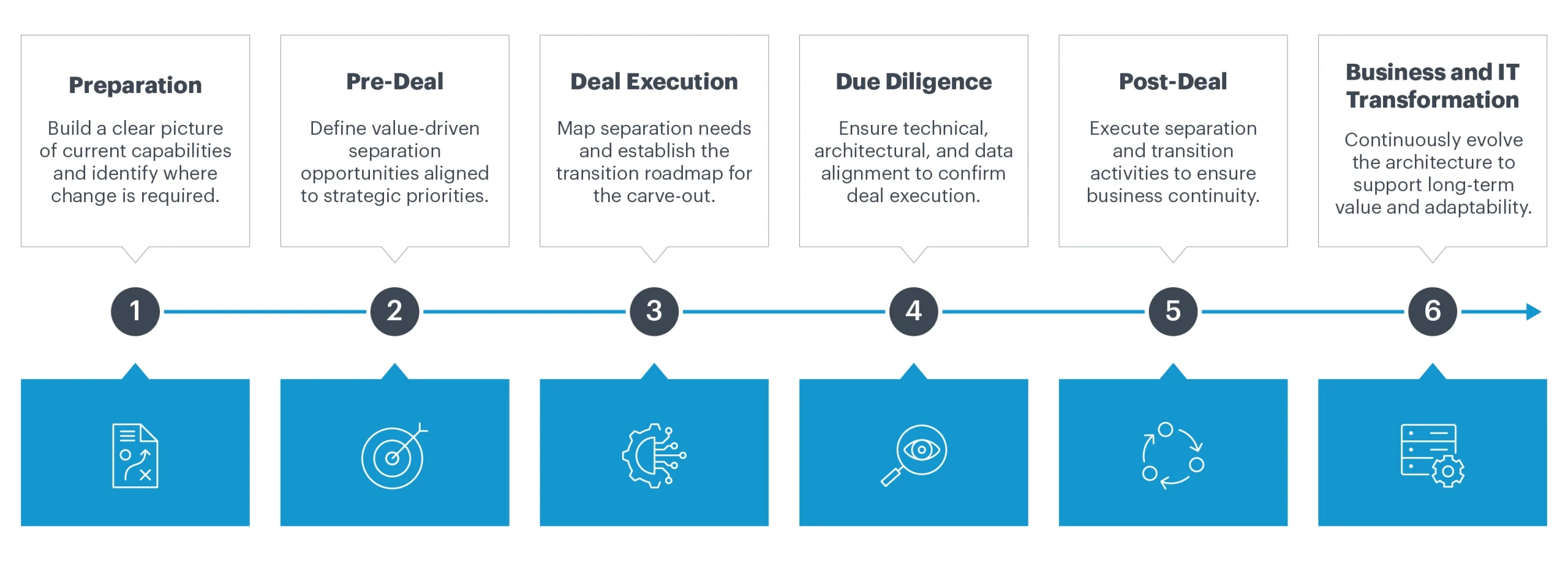
Phase 1 – Preparation
Enterprise architects build the as-is architecture baseline: capabilities, applications, data flows, and organisational structures. This exposes hidden dependencies that will influence the separation. Early change-impact assessments begin here, identifying affected roles and teams and setting the foundation for communication and engagement.
Phase 2 – Pre-Deal
Architects work with leadership to evaluate separation scenarios and their implications. Which units can be separated cleanly? What shared services require temporary agreements? What are the target operating models for the remaining and divested organisations? As scenarios solidify, employees begin to understand how the separation could affect them, making transparency crucial.
Phase 3 – Deal Execution
The architecture team translates the deal into an actionable separation plan: Day-1 requirements, TSA scope, and a transition architecture that bridges shared operations. Communication protocols are essential so employees know timelines, responsibilities, and where to get support.
Phase 4 – Due Diligence
Enterprise architects provide buyers with a transparent view of IT landscape complexity, data architecture, and integration patterns. Strong architectural due diligence supports accurate valuation and minimizes post-deal surprises.
Phase 5 – Post-Deal Execution
This is where planning becomes reality: separating or replicating systems, migrating data, rerouting integrations, and transitioning users. Enterprise architects orchestrate these cutovers. For employees, this is the most intense phase – new systems, processes, and sometimes employers. Training and support protect morale and productivity.
Phase 6 – Business and IT Transformation
After separation, both organisations must evolve their architectures for their new strategic goals. Architects help resolve technical debt, define target architectures, and uphold clean-core principles. For people, this phase marks a shift toward building a new organisational identity.
Why Follow a Structured Approach?
A structured approach ensures decisions are based on architectural logic, not ad-hoc reactions. It aligns business, IT, and negotiation teams on common priorities, reduces uncertainty, accelerates deal execution, maintains compliance, and stabilises operations during the transition. Equally important, structure provides clarity for employees. When people understand timelines, expectations, and the path ahead, anxiety decreases. Structure becomes a leadership tool that signals competence and care.
Untangling Interdependencies: The Challenge of Shared Systems and Processes.
One of the most difficult aspects of divestitures is separating tightly connected systems and processes, especially in SAP-centric landscapes where integration is intentional and extensive. Enterprise architects create a comprehensive map of applications, integrations, and data flows. For divestitures, this map is layered with a separation overlay showing which integration points will be severed, replicated, or supported through TSAs.
For example, a business unit divesting from a shared SAP S/4HANA instance may involve intercompany transactions, shared master data, and cross-company code processes. Architects must assess each dependency and design the appropriate target landscape – whether a selective migration, a system copy, or a phased TSA-based approach. Interdependencies are also human: shared processes mean shared relationships. When interfaces are separated, communication channels are too. Enterprise architects plan both technical and organisational handovers to ensure operational continuity.
Data Separation: The Carve-Out Challenge.
Data is often the most complex aspect of divestiture. Master data may be shared, financial history intertwined, and regulatory constraints may require certain data to remain accessible to both parties.
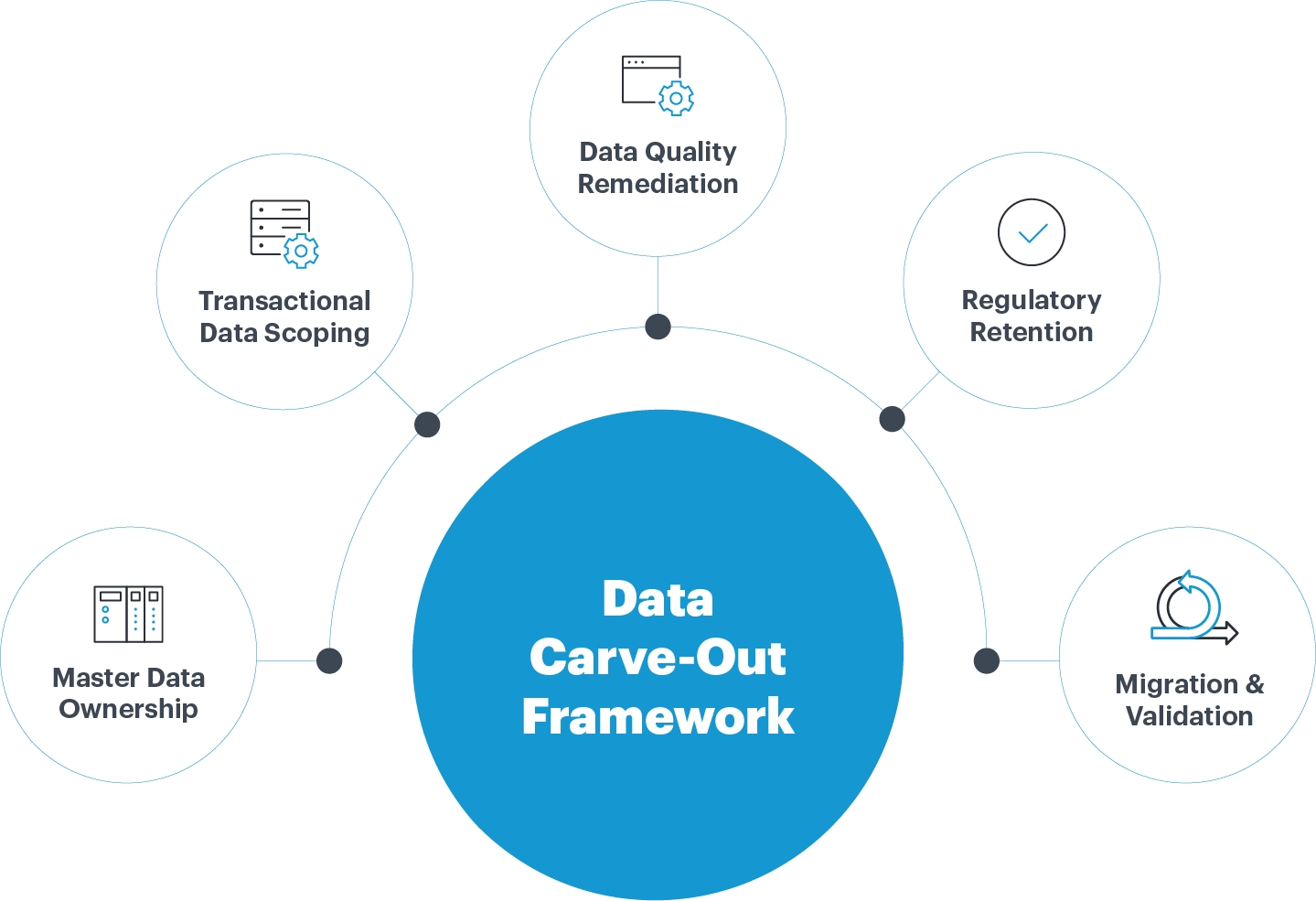
A structured data carve-out approach includes:
- master data ownership assignment
- transactional data scoping
- data quality remediation
- regulatory retention compliance
- migration and validation
Finance, legal, compliance, IT, and business teams must agree on ownership, retention, and access. Architects provide the data architecture transparency needed to make these decisions confidently. Data changes are also personal: long-used reports, dashboards, and analytics often need to be rebuilt. Supporting users through these changes is essential for a successful carve-out.
How Enterprise Architects Create Value Across the Divestiture Lifecycle.
Enterprise architects provide transparency, convert strategic goals into architectural decisions, identify risks early, design transition and target architectures, and supply the evidence required for TSAs. They keep technical feasibility, operational continuity, and strategy aligned. They also serve as translators between leadership and technical teams – an invaluable role in high-pressure divestitures.
At Westernacher Consulting, we’ve seen how enterprise architecture turns divestitures from reactive exercises into proactive, value-generating programmes. By applying the six-phase model and keeping people at the centre, clients achieve clean separations that protect value and enable future growth.
Conclusion: Letting Go with Confidence.
Divestitures touch every layer of an organisation: strategy, processes, systems, data, and especially people. Westernacher’s approach, supported by the SAP Enterprise Architecture Framework, provides the rigour needed to navigate this complexity – from the Architecture Vision through Business and Solution Architecture to Roadmap and Transition Planning. But methodology alone is insufficient. Successful divestitures require leaders who acknowledge the human dimension – uncertainty, identity shifts, and fear. Enterprise architects provide both analytical structure and human awareness.
At Westernacher Consulting, we believe the architecture of letting go is not about dismantling – it is about redesigning. Divestitures create the opportunity for two stronger, more focused organisations. That journey begins with clear architecture, structured execution, and a commitment to the people at the heart of the change.
For more insight on our M&A methodology including tool-supported transformation activities, get in touch with:

Matthias
Engelmayer
Engelmayer
Senior Consultant Business Transformation Management,
Westernacher Consulting
Westernacher Consulting