Article
By David Cockbaine, Director – Digital Core (SEA), Westernacher Consulting
Share this article
Follow us on Linkedin
Every leadership team I speak with is wrestling with the same question: Public Cloud or Private Cloud? Each path promises benefits but also hidden trade-offs that can make or break a transformation program.
In practice, the right decision depends on business reality, not theory. For example, a client in the heavily regulated telecommunications industry chose Private Cloud. Why? because of extremely complex workflow and automation requirements. Private Cloud gave them greater functional control, flexible upgrade cycles, data sovereignty and residency alignment, and infrastructure isolation. The trade-offs were also clear: higher total cost of ownership, slower innovation cadence, increased risk of technical debt, and a heavier internal IT burden.
By contrast, a fast-growing, lean digital startup is often a strong candidate for SAP S/4HANA Public Cloud edition. Their primary drivers are speed to value going live in weeks rather than months and a subscription-based OPEX model that reduces or eliminates upfront hardware investment. They also benefit from immediate access to SAP’s latest innovations (including Gen-AI capabilities) and best practice processes that support global scaling without a large internal IT team. The trade-offs include stricter standardization, less control over release timing, and constraints around configuration and data models compared to more customized landscapes.
Over three decades in SAP consulting, I’ve seen the pendulum swing from on‑premises to cloud‑first. Today, choosing between Public Cloud and Private Cloud is one of the most consequential decisions a leadership team will make. It affects cost, agility, compliance, and how quickly you can innovate.
Over the past few years, SAP customers have been pushed into a cloud decision not by theory, but by very real pressures: ageing on-prem hardware nearing end of life, rising Basis support costs, talent shortages, and SAP’s accelerated innovation cadence. For many organisations, the question isn’t “Should we move to Public or Private Cloud?” – it’s “We have to choose soon, or we risk operational disruption, rising cost, and falling behind.”
Imagine this: your ECC platforms are approaching renewal, key integrations are becoming harder to maintain, and the business is demanding analytics, automation, and AI that your current landscape can’t support. You now face a decision that will shape your cost model, your agility, and your capacity to innovate for the next decade.
This article explains the differences, through an SAP‑centric lens, explains real triggers behind the choice, what each model enables, and how to make the right decision for your organisation.
1 What typically forces this decision
Most SAP customers reach this point because one or more of these triggers’ hits at the same time:
- End of life infrastructure or datacentre renewals that force a move or invest decision.
- Rising operational strain and support overhead across Basis, patching, and monitoring.
- Pressure for faster innovation, from analytics to automation to AI, that ECC or heavily customised systems can’t support.
- Upcoming SAP transformation milestones, such as S/4HANA migrations or greenfield vs selective transformation decisions.
- Audit, compliance, or data residency pressures that require rethinking where workloads live.
- Business change, growth, restructuring, M&A that legacy architectures can’t scale to meet.
These triggers make the cloud model choice unavoidable and time sensitive.
2 Understanding the Cloud deployment models
2.1 SAP Public Cloud
SAP Public Cloud services are operated and managed by SAP. (They may run on multi‑tenant infrastructure operated by hyperscalers such as Microsoft Azure, AWS, and Google Cloud, but they are provisioned, managed and operated by SAP. You consume services on demand, and the provider (SAP) manages capacity, resilience, and most platform updates.
- Standardised services with rapid provisioning
- Automatic updates handled by the provider
- Subscription/Pay‑as‑you‑use commercial model
- High scalability and global availability
2.2 SAP Private Cloud
SAP Private Cloud dedicates infrastructure to a single organization. In the context of a RISE engagement, the infrastructure is dedicated to your organisation to ensure high performance and data isolation. This environment is typically hosted on Hyperscalers (such as AWS, Azure, or GCP) but is managed holistically by SAP under a single Service Level Agreement (SLA).
- Single‑tenant isolation and stronger control of configurations
- Greater flexibility for custom code and complex integrations
- Tailored governance, security, and compliance models
- Predictable capacity planning and change management
2.3 Integration and extensibility in the Cloud
SAP Business Technology Platform (BTP) serves as the essential innovation layer that preserves a “clean core” across both public and private cloud models. By shifting customisations and integrations to BTP, organisations can avoid modifying the underlying ERP code, ensuring that the core remains agile and easily upgradeable.
For the Public Edition, BTP is the primary vehicle for side-by-side extensibility and advanced analytics; for the Private Edition, it provides a structured path to decouple legacy enhancements, allowing for a modernised architecture that supports AI, automation, and seamless connectivity with third-party systems.
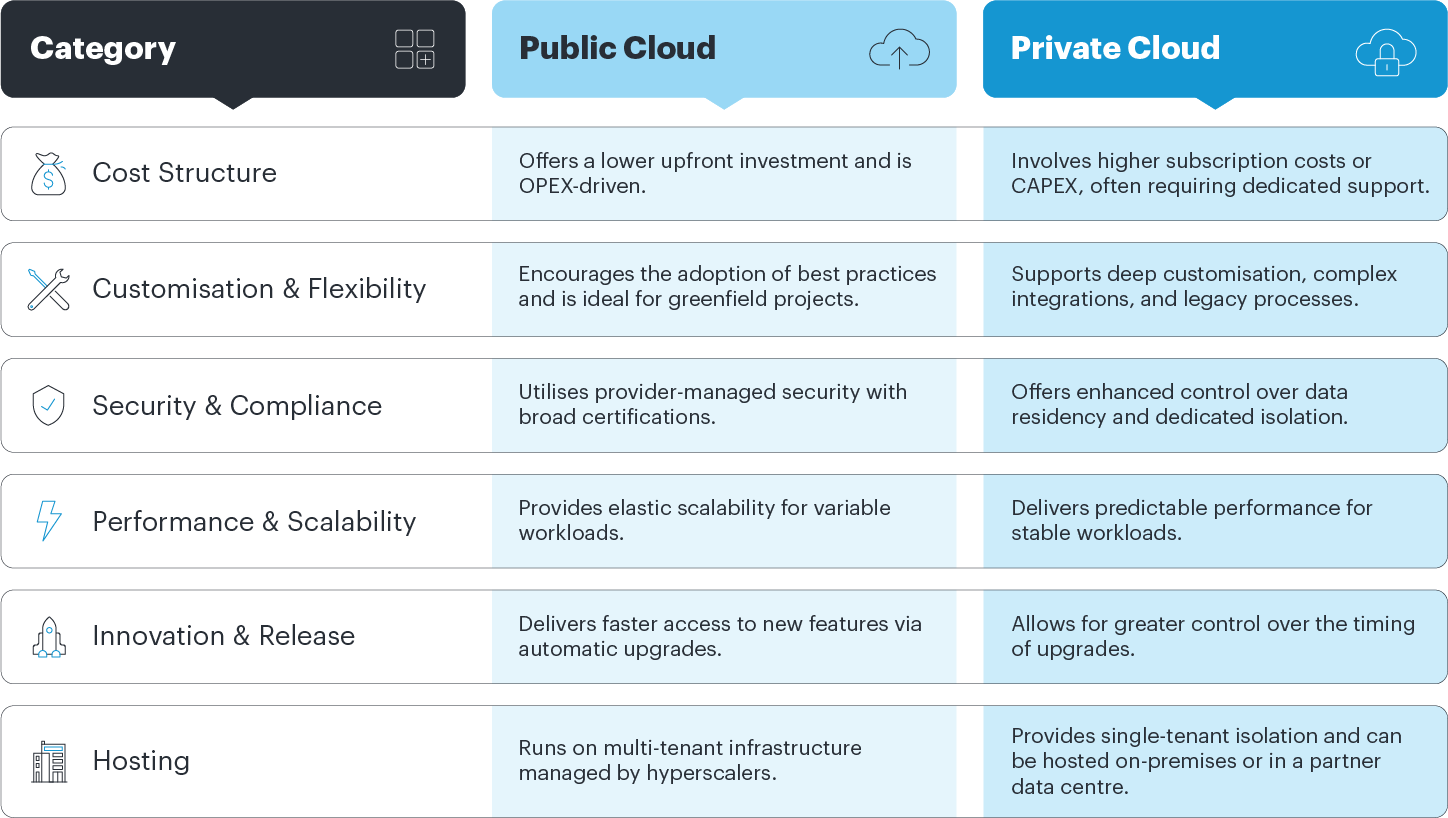
3 Comparing Public and Private Cloud
3.1 A. Cost Structure
Public Cloud
Lower upfront investment, OPEX‑driven, reduced infrastructure and Basis overhead, updates included.
Private Cloud
Higher subscription or CAPEX if hybrid, dedicated support often required, but costs align to customization and control needs.
3.2 B. Customisation and Flexibility
Public Cloud
Encourages best‑practice adoption with limited core modification; ideal for greenfield.
Private Cloud
Supports deep customisation, legacy processes, and complex integrations; better for brownfield/selective transformation.
How do integrations survive release upgrades? (Future-proofing either model)
Frequent upgrades especially in Public Cloud, raise concerns about integration stability. Best practice patterns help ensure resilience:
- Use API first integration patterns (released APIs, events, CDS views) designed for version stability.
- Avoid direct database access or classic exits, as these are first to break during upgrades.
- Leverage middleware/integration layers (SAP Integration Suite, Azure Integration, Boomi) to decouple systems and absorb change.
- Use event driven integrations for versioned, durable communication.
- Maintain disciplined regression testing aligned to SAP’s release cycle, whether automated (Public) or controlled (Private).
Public Cloud
Upgrade impact can be minimized significantly when integrations use released APIs and side-by-side extensions (BTP), supported by automated regression testing aligned to SAP’s release cycle.
Private Cloud
Flexibility is preserved when custom logic is wrapped, documented, and decoupled from the core, paired with disciplined testing before upgrade windows.
3.3 C. Security and Compliance
Public Cloud
Provider‑managed security with broad certifications; multi‑tenant model may raise concerns in highly regulated sectors.
Private Cloud
Enhanced data residency control, dedicated isolation, easier alignment to bespoke governance or audit needs.
3.4 D. Performance and Scalability
Public Cloud
Elastic scalability and global performance optimisation; ideal for variable or seasonal workloads.
Private Cloud
Predictable performance with planned scaling; best for stable, well‑understood workloads.
3.5 E. Innovation and Release Management
Public Cloud
Faster access to new features with automatic upgrades; requires strong change management and process agility.
Private Cloud
Greater control over upgrade timing (within vendor windows); more time for testing integrations and custom code.
3.6 F. Implementation speed and Organisational impact
Public Cloud
Faster baseline deployment, stronger process standardization requirement
Private Cloud
More flexibility, but governance/testing effort increases with custom scope
3.6.1 Public Cloud: Fast, Standardised, and Less Disruptive to IT Operations
Public Cloud implementations typically move faster because the solution is delivered with preconfigured best practice processes and limited scope for deep customization.
- Speed: Rapid deployment using fit to standard accelerators and predefined configuration.
- Organisational Impact: Requires process alignment rather than system tailoring, which means more change management effort for the business, but significantly less technical effort for IT.
- IT Operating Model Shift: Internal teams transition away from hands on Basis and infrastructure work, focusing instead on process ownership, data quality, and continuous adoption of new features.
3.6.2 Private Cloud: More Flexible but Slower and Heavier on Internal Resources
Private Cloud projects generally take longer due to wider configuration options, custom code remediation, and deeper integration complexity.
- Speed: Implementation timelines extend where legacy processes, custom objects, or non‑standard integrations must be rebuilt or adapted.
- Organisational Impact: Requires stronger involvement from IT, architects, and operations teams. The business faces less “process compromise,” but the organisation must absorb a more resource intensive project.
- IT Operating Model Shift: Internal teams retain more technical responsibility, governance, change control, upgrade planning, and custom code management; which can reduce long term disruption but increases project overhead.
4 How to choose: A practical decision framework
4.1 How standardised are your business processes?
- Fit to standard → Public
- Highly tailored → Private
- Adopt best practices with minimal customisation → Public Cloud
- Mission‑critical, highly tailored processes → Private Cloud.
4.2 What is your appetite for continuous innovation?
- Agile, Fastmoving → Public
- Controlled cycles → Private
4.3 What are your regulatory and data protection requirements?
For highly regulated industries — such as banking, pharmaceuticals, or the public sector — the SAP S/4HANA Cloud Private Edition is generally considered the best fit.
- Highly Regulated Industry → Private
- Data Residency and Sovereignty → Private
4.4 Are you modernizing or replicating existing processes?
- Modernising → Public
- Replicating existing processes → Private
4.5 What level of internal IT capability will you maintain?
- Reduce infra/Basis footprint → Public
- Maintain strong technical oversight → Private
4.6 Do you expect unpredictable or high growth?
- Variable or rapid scaling → Public
- Stable demand → Private
5 Hybrid Cloud: The middle ground
Many organisations adopt hybrid architectures, combining the control of Private Cloud with the elasticity and services of Public Cloud.
- Run SAP S/4HANA in Private Cloud while using analytics/AI services in Public Cloud
- Keep regulated data private, place innovation workloads in public
- Leverage public cloud for burst capacity and disaster recovery
6 Insight: What we see in SAP S/4HANA programs
Across SAP S/4HANA transformations, certain patterns show up consistently:
- Projects start with a technical mindset but evolve into business transformations.
- Custom code volume is almost always underestimated and shapes the cloud choice.
- Stakeholders often try to recreate legacy processes, slowing decisions and inflating scope.
- Integrations and data become the true critical path, even more than configuration.
- Business wants innovation faster than IT can provide, shaping preference for Public Cloud.
- Continuous delivery readiness is low, requiring new governance and testing models regardless of cloud path.
7 Conclusion
Choosing between Public and Private Cloud is ultimately strategic. Public Cloud excels at speed, standardisation, and continuous innovation. Private Cloud shines when you need flexibility, customisation, and strict control. Align the model to your operating priorities, compliance needs, and change‑management maturity to maximise value.
The best choice is not about personal preference, it’s about operational readiness, risk tolerance, appetite for innovation and about how you plan to evolve over the next three to five years.
Need some help getting started? Want to know what your best option might be? Worried your competitors might be getting ahead?
If you’re evaluating your path to SAP S/4HANA Cloud, Westernacher can help you assess fit-to-standard readiness, integration complexity, and change maturity, then map a practical roadmap for public, private, or hybrid.
Get in touch to schedule a brief exploratory conversation about your current ERP landscape and the fastest path to measurable value
If you’re evaluating your path to SAP S/4HANA Cloud, Westernacher can help you assess fit-to-standard readiness, integration complexity, and change maturity, then map a practical roadmap for public, private, or hybrid.
Get in touch to schedule a brief exploratory conversation about your current ERP landscape and the fastest path to measurable value