Share this aricle
Follow us on Linkedin
In modern manufacturing environments, keeping production lines supplied on time is no longer just about moving materials; it is about orchestrating material flow with precision. Tugger trains have long played a key role in lean manufacturing by transporting components, raw materials, and finished goods along fixed routes. This approach reduces forklift traffic, supports just-in-time delivery, and improves shop-floor safety.
However, while tugger trains effectively solve the physical movement of materials, many organizations still struggle with the system integration. Without the right systems in place, staging, visibility, and control across Production Supply Areas (PSAs) quickly become manual, fragmented, and error prone.
This is where SAP Extended Warehouse Management (SAP EWM) and its Distribution Equipment (DE) process come into play, transforming tugger trains from simple transport tools into a fully integrated, system-driven production supply mechanism.
By the end of this blog, you will understand how tugger trains and SAP EWM integration can streamline production supply and increase operational visibility.
Tugger Trains and SAP EWM Distribution Equipment.
SAP EWM Distribution Equipment (DE) streamlines multi-step staging for production by digitally managing vehicles such as tugger trains and tightly integrating them into warehouse and production processes.
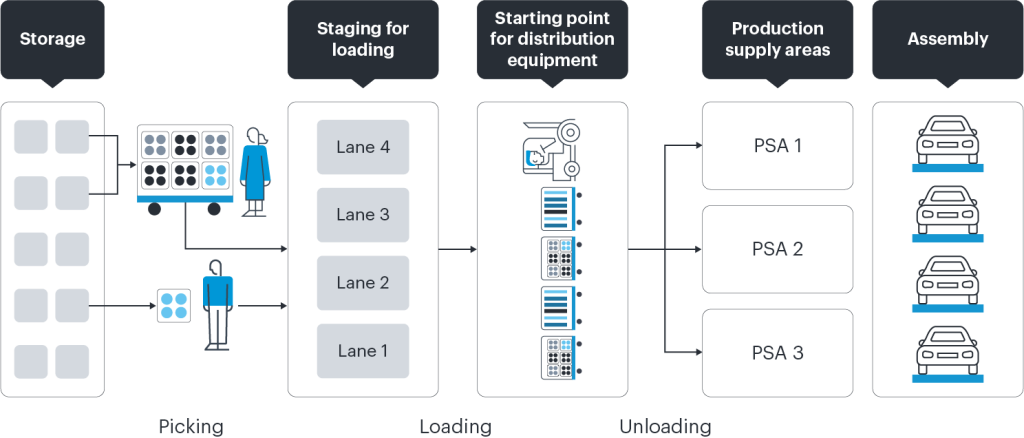
With SAP EWM DE, components move seamlessly from storage to Production Supply Areas (PSAs) through a controlled, system-driven process that includes:
- RF-guided picking of components into structured Handling Units (HUs) at staging stations
- Loading of HUs onto distribution equipment (such as tugger trains)
- System-confirmed unloading at the final PSA
- PSA clearance after postproduction or assembly
Compared to traditional manual approaches, this provides significantly higher transparency, reliability, and operational discipline.
Behind the scenes, the process is supported by key SAP EWM configuration elements such as:
- Warehouse structure and storage bins
- Activities and warehouse tasks (WT)
- Handling Units (HUs)
- Process-Oriented Storage Control (POSC)
- Layout-oriented storage control (LOSC)
- RF (Radio frequency device) confirmations
All activities are fully tracked and monitored within EWM.
Problems and opportunities in Manufacturing Supply.
In manufacturing environments, distribution equipment includes conveyors, robots, forklifts, and tugger trains. While these assets are essential, they often expose broader operational challenges that cannot be solved by physical equipment alone.
Common challenges include:
- Technology gaps caused by manual processes and siloed systems
- Labor shortages and increasing dependency on skilled operators
- Inventory imbalances leading to shopfloor stockouts or excess inventory
- Increasing operational and labor costs
- Cybersecurity risks in connected and automated environments
- Fragmented distribution networks that reduce visibility and control
These challenges create a strong case for automation, system integration, and real-time orchestration.
How SAP EWM addresses these challenges.
SAP EWM provides a strong foundation for leveraging distribution equipment more effectively through automation, visibility, and system integration.
Key capabilities include:
- Real-time visibility and tracking of material movements and locations
- Automation of routine processes, reducing manual effort and errors
- Exception management to proactively handle disruptions
- Integration with IoT and automation technologies, including RFID and AGVs
- Material Flow System (MFS) capabilities for highly automated warehouses
- Optimized resource utilization across equipment and labor
- Advanced production supply functionality for greater control over PSAs
Together, these capabilities enable manufacturing organizations to move from reactive execution to controlled and predictable production supply.
Key Insights: SAP EWM distribution equipment in action.
With SAP EWM DE, organizations can support multi-step component supply to Production Supply Areas with full system transparency.
The process typically begins with a production-driven request, such as:
- A KANBAN signal
- A Just-in-time call
- A stock transport or Ad Hoc movement
- A posting change
- An outbound delivery
- A production material request
From there, the process flows as follows:
- A picker retrieves components and places them into structured racks (configurable) or Handling Units (HUs).
- During picking confirmation, the exact rack position is recorded in the system.
- Filled racks are moved to a loading preparation station.
- A loader assigns racks to a specific tugger train route (LOSC).
- The tugger train driver delivers materials to the PSA, guided and validated by the system.
At every step, SAP EWM ensures confirmation, traceability, and operational control.
Benefits and value to the business.
SAP EWM with Distribution Equipment functionality delivers tangible business value by bringing structure, visibility, and efficiency to complex material handling and transport processes, especially in multi-step production supply scenarios.
Organizations benefit from:
Increased Control and Visibility
Full transparency across the production supply process from warehouse staging to final delivery at the Production Supply Area.
Optimized Material Flow
Better synchronization of material movements ensures consistent and timely supply to assembly and production lines, reducing bottlenecks and line stoppages.
Enhanced Resource Utilization
More efficient use of physical assets such as tugger trains, racks, forklifts, and labor through system-guided execution and planning.
Streamlined Processes
Simplification of complex multi-step handling processes through standardized, system-driven workflows.
Reduced Errors and Higher Accuracy
Automation and RF-guided execution significantly reduce manual intervention, minimizing picking, loading, and delivery errors.
Seamless Integration
Tight integration with SAP Production Planning (PP) and Plant Maintenance / Enterprise Asset Management (PM/EAM) ensures alignment between warehouse, production, and maintenance operations.
Moving from Material Transport to Intelligent Orchestration.
Modern manufacturing demands more than simply moving materials that require intelligent orchestration across systems, equipment, and people.
If your organization is looking to gain tighter control over production supply, improve material flow, and unlock the full potential of tugger trains within SAP EWM, now is the time to act.
Partner with Westernacher Consulting to design and implement an SAP EWM Distribution Equipment solution tailored to your manufacturing environment. With decades of hands-on industry experience, we help organizations move beyond basic execution toward resilient, high-performing, future-ready supply chains.